
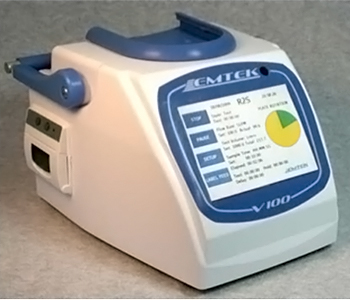
The V100 controller is now compatible with laser particle counters.
Both laser particle counters and microbiological air samplers are important tools used to determine air quality in cleanrooms and other environments, as well as in compressed air and gas systems. However, these two air sampling deviceshave very different methods of operation and provide different environmental data to the user. For this reason, most critical environments require the use of a combination of both types of devices to assess the condition of that environment or system. To better understand why you need both devices to effectively sample the air in your facility, here is a brief overview of the similarities and differences between them:
The Difference
Laser particle counters (LPCs) allow for the total number of particles in a given volume of air, including ambient air and compressed air and gases. The total particle count includes both living and non-living (bacterial) particles, but does not differentiate between the two sources. LPCs also classify by size, with many common particle counters offering particle channel sizes from 0.3 to >15 microns. LPCs also offer a variety of sampling rates, from 0.1 liters per minute (LPM) to 100 LPM. On the other hand, bacterial air samplersassess the living particles, also known as bacterial particles, in the air, rather than the total coarse particle count.
There is also a big difference in the time it takes to get results. Laser particle counters can provide results almost immediately, while microbiological air samplers require an incubation period of two to seven days before they can provide results. LPCs save you the time of waiting for results from microbiological air samples, as they provide immediate results of the total particle load in your environment.If monitored over time, these results can quickly tell you whether your environment or system is in a normal state of control and within appropriate limits for operation (e.g., HVAC system is operating correctly, equipment is not malfunctioning and emitting unwanted materials, etc.).
Similarities
Similarities
There are quite a few similarities between many popular laser particle counters and EMTEK’s V100 Controller, which operates microbiological air samplers (e.g., R2S, RAS, and RCG). Most portable LPCs from 1 CFM (28.3 LPM) to 100 LPM and the V100 Controller provide vacuum to a remote sampling device (probe or air sampler), allowing remote monitoring of critical areas, such as ISO 5 Filling Lines, Isolators, etc.This minimizes the risk of contamination of that environment and allows the probe or air sampler to be placed closer to the critical sampling location (e.g., by the filling needle, stopper bowl, capping station, etc.), while the controller/vacuum source can be located outside the critical area. Additionally, the EMTEK V100 Controller offers similar flow rates to the most popular LPCs on the market, with flow rates of 28.3, 50, and 100 LPM, allowing the same sample volume, in the same amount of time, as the LPC.
EMTEK also ensures their devices offer a lot of flexibility in terms of pre-programmed acquisition times and integration options. Like most popular LPCs, EMTEK’s V100 controller, along with its diverse sampling head options (R2S, RAS, and RCG), allows for significant programming with user-specified sample delays, sample run times, and sample hold times.as well as control of total sample volume or time. Additionally, as is common with LPCs, an integrated thermal/label printer is included to output all key sample parameters, which can be affixed to the test environment or attached to your sampling documentation, making data transfer easier and significantly more traceable than other microbiological gas samplers.
As required by most companies and regulatory agencies, a complete air sampling program includes both viable (microbial) and non-viable (total particulate) testing equipment to monitor and control your critical environment or system. Having compatible monitoring equipment, with similar programmable collection, flow, etc. functions, will significantly simplify your sampling plan with superior efficiency, allowing you to maintain proper environmental control and meet regulatory agency guidelines.